Apologies for reviving an old thread, but it seemed more appropriate than creating a new one for what I wanted to share.
Already a lot of good info shared here, but I'm going to consolidate and add my two cents.
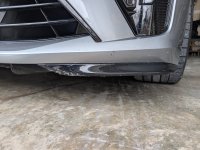
These pieces are definitely a wear item unfortunately. When I bought my preowned 4 BW, the two pieces were scuffed up pretty badly - one of them was missing a chunk. This is why I didn't really care for the exterior CF trim as much as I love CF.
Taking it off is a little tricky. As already mentioned, there are 4 T5 screws - easy. Then there are these 3 white clips that need to be pressed in (small flat head will do) and pushed upwards. Taking off the bumper would obviously make this easy, but you definitely do not need to do that. I didn't and just used a ramp to get some space while laying underneath. Apparently these white clips are prone to breaking, but I didn't have any break on me. Now, I will say they are close to impossible to get them back in. I assume they are easy to pop back in if the bumper is removed. That being said, I didn't even bother popping them back in and just secured them with the 4 T5 screws - seems to do the job just fine.
If you want to replace them, the part numbers are 84590904 (passenger), 84590905 (driver). They come painted so all you have to do is install them. This is the most expensive option and I believe there is a core charge involved.
Next option is
Tapout Tuning's CF option. This is a way better deal and you get two CF pattern options. That said, if you don't have any other CF on your car, it may look off, but that's subjective.
Last option is to FIX IT YOURSELF (I suppose you could pay one of those mobile car paint guys to do it as well, but that would be more $). Guys, it's easy and cheap. It will take a day or two, but that's mostly due to sanding and paint curing time. It can be fun depending on what you're into.
- Depending on how bad the rash is, use an appropriate grit sandpaper to level as best you can.
- There are different variants, but use this plastic body filler to fill in any gaps or voids. Use a glove and just smooth it over as you taper off the edges. Doesn't have to be perfect because you're going to sand again. Once dried, use an appropriate grit sandpaper (probably higher than originally used) to blend the filler into the rest of the piece. Lastly, use a high grit sandpaper to get as smooth of a surface as you can. Rinse clean and completely dry.
- Now you have two options: use gloss black wrap (this is the correct amount of what you'd need) or spray paint with this and this.
- I started with the wrap. It was pretty hard, but I finally got it about 90%. This definitely looked the best, but I couldn't get the edges to lay down properly.
- I took off the wrap and went the spray paint route. I'm not sure which was harder. I messed up 3 times before getting it right. It's definitely an art to get the spray paint smooth. If you mess up, you basically have to sand it back down with high grit and start again. Thankfully it blends well and obviously the coverage was way better than the wrap so I didn't need to worry about the edges. In my opinion, this is the way to go and is the same cost as the wrap.
- This will 100% fix the issue, but even if it's not perfect, you or anyone else will not be able to tell because you'd really have to get down and look at it closely.
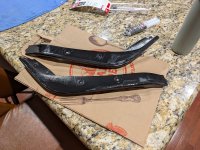
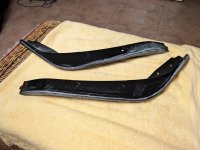
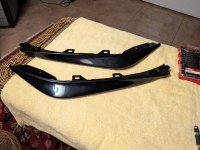
- I'll post some pictures below. You can see different parts of the steps; the picture with the yellow towel is when the pieces were wrapped and the last picture is of them painted. Lastly, I am getting these pieces PPFd, but that's not shown.